
Have you ever wondered when you should get a dental X-ray or why your dentist insists on taking them regularly? Many patients worry about radiation exposure or question the necessity of X-rays, especially if they aren’t feeling any pain. It’s natural to feel a bit anxious or unsure. You might be dealing with a persistent toothache that doesn’t show any obvious signs of a cavity, or perhaps it’s been a while since your last dental visit and you’re concerned there could be hidden issues. These are the kinds of situations where dental X-rays become invaluable. They allow dentists to look beyond what’s visible to the naked eye, uncovering problems lurking beneath the surface of your teeth and gums.
At Southside Dental Care, we understand those concerns and want to reassure you. Our approach is both professional and compassionate – we use the safest, most up-to-date imaging technology to ensure your comfort and wellbeing. Dental X-rays are crucial diagnostic tools that help us catch issues early and plan treatments accurately. In fact, skipping X-rays when they’re needed could mean missing the early warning signs of decay, infection, or bone loss. By the end of this article, you’ll understand the importance of dental X-rays in maintaining a healthy smile, know when to consider getting one, and see how our team ensures the process is safe, quick, and comfortable for you.
Why Are Dental X-Rays So Important? (The “Why & How”)
Dental X-rays are more than just pictures – they’re a window into parts of your mouth that are otherwise hidden. During a preventive dental check, your dentist might recommend X-rays to ensure everything is healthy beneath the surface of your teeth and gums. Here’s why these images are so valuable and how they work:
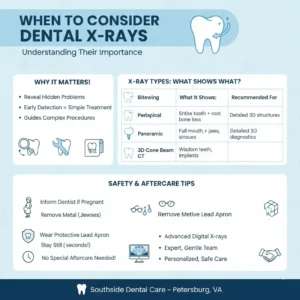
- Revealing Hidden Problems: X-rays can spot issues that aren’t visible during a regular exam. Tiny cavities between teeth, infections at the tooth root, or bone loss from gum disease can all be detected early with X-ray imaging. By catching problems early, we can treat them before they turn into painful emergencies. This early detection means a simpler and less costly treatment – and ultimately saves your teeth and your budget in the long run.
- How X-Rays Work: Dental X-rays (also called radiographs) use a very low dose of radiation to create an image of your teeth, jaws, and surrounding structures. In our office, we use digital X-ray technology, which means the images are captured instantly with electronic sensors instead of old-fashioned film. The process is quick and painless – you’ll bite down on a small sensor or rest your chin on a panoramic machine, a brief X-ray beam passes through, and an image appears on our computer screen within seconds. The imaging benefits of modern digital X-rays include clearer pictures that we can enlarge or enhance, and significantly less radiation exposure compared to traditional film X-rays.
- A Key Part of Dental Diagnostics: X-rays are a cornerstone of dental diagnostics, guiding dentists in everything from identifying a tiny cavity to planning complex treatments. For example, if you’re considering a dental implant or your child is getting braces, X-rays provide critical information about bone structure and tooth alignment that we just can’t get from a visual exam alone. Even for advanced procedures like oral surgery, comprehensive imaging is indispensable for planning and safety. In short, X-rays give us a complete picture so we can offer you the right solutions.
- Addressing Safety Concerns: It’s normal to worry about X-ray radiation, but dental X-rays are extremely safe when used judiciously. The amount of radiation from a routine dental X-ray is very low – in fact, it’s often less than what you’d receive from natural background radiation in a single day just by going about your life. We also take every precaution to minimize exposure: you’ll wear a lead apron and thyroid collar for protection (as needed), and our digital X-ray units focus the X-ray beam precisely to the area of interest. Dentists follow the principle of “ALARA” (As Low As Reasonably Achievable), meaning we only take X-rays when necessary to aid in diagnosis or treatment. If you’ve been postponing X-rays due to safety worries, rest assured that the benefits far outweigh the minimal risks when they’re appropriately used.
Comparing Types of Dental X-Rays (What Shows What?)
Not all dental X-rays are the same. Depending on your situation, we might recommend a specific type of X-ray to get the best view. Here’s a quick comparison of the common types of dental X-rays and when each is used:
| Type of X-Ray | What It Shows | When It’s Recommended |
| Bitewing X-ray | Shows the crowns of your upper and lower back teeth in one image (you “bite” on a small tab). Great for detecting cavities between teeth and checking bone levels. | Routine check-ups (often once a year or as needed) to catch tooth decay between teeth or monitor existing fillings. |
| Periapical X-ray | Captures an entire tooth from crown to root, plus the surrounding bone. Useful for seeing tooth root structure and any infections at the root tip. | When you have symptoms in a specific tooth (e.g. toothache, abscess) or for treatment planning like root canal therapy. |
| Panoramic X-ray | A broad, full-mouth view of all teeth, jaws, sinuses, and jaw joints in one image. The machine rotates around your head to take this image. | For comprehensive evaluation: often taken for new patients, or to plan treatments like wisdom tooth extractions, dental implants, or orthodontics (braces). Gives a big-picture view of oral health. |
| 3D Cone Beam CT (CBCT) | A special 3D scan that shows teeth, bones, and nerves in incredible detail (higher radiation than standard X-ray, so used selectively). | Complex cases and advanced diagnostics – for example, planning oral surgery or implant placement, evaluating impacted teeth, or diagnosing problems that regular X-rays can’t fully explain. Used only when necessary due to higher exposure. |
Understanding these X-ray types helps you see why your dentist chooses a particular image. For instance, a small cavity might only need a bitewing X-ray, but planning an implant may require a panoramic or 3D image for precision.
What to Expect During a Dental X-Ray (Step-by-Step Guide)
If you’re nervous about the X-ray process, it may help to know exactly what happens when you come in for one. The good news is that getting a dental X-ray is fast, painless, and uncomplicated. Here’s a step-by-step look at how we do it at Southside Dental Care:
- Preparation: First, we’ll cover you with a lead apron and a thyroid collar (a small protective drape around your neck) to shield you from any minimal scatter radiation. You’ll be asked to remove any metal jewelry or eyeglasses that could interfere with the image. If you have any questions or concerns – for example, if you’re pregnant or think you might be – be sure to let us know at this stage so we can take extra precautions or decide if an X-ray is appropriate.
- Positioning: Next, we position the X-ray. For a small X-ray (like a bitewing or periapical), you’ll gently bite down on a sensor or film holder placed in your mouth. It might feel a little awkward for a few seconds but shouldn’t hurt. For a panoramic X-ray or 3D scan, you’ll stand or sit still and bite on a small peg; the machine will rotate around your head. Our team will help position you correctly – proper positioning is important to get a clear image.
- Taking the X-Ray: We step out of the room (or behind a protective barrier) briefly while the X-ray is taken – this is simply to avoid repeated exposure for us, since we take X-rays all day long. We’ll ask you to stay very still for a couple of seconds. The X-ray machine will emit a click or whir, but you won’t feel anything. The exposure time is only a fraction of a second for digital X-rays. It’s over before you know it!
- Immediate Results: With our digital system, the image of your teeth and jaws pops up on the computer almost instantly. You won’t be left waiting or wondering. If it’s a traditional film X-ray (less common nowadays), it might take a few minutes to develop the film, but at Southside Dental Care we’ve invested in digital tech for speed and accuracy.
- Review and Next Steps: Finally, the dentist will review the X-ray with you. We’ll point out what we see – whether it’s a tiny cavity starting between your molars, an abscess at the root of a tooth, or (hopefully) that everything looks perfectly healthy. We’ll explain any findings in plain language. If a problem shows up, we’ll discuss treatment options. If all is well, we’ll simply use the X-rays as a baseline to compare with future images. Feel free to ask questions – we want you to fully understand your oral health.
Comfort Tip: If you have a strong gag reflex, let us know. We have techniques and smaller sensors to make the process easier. And remember, the actual X-ray exposure is just a second – if you can hold still and count “one…two…”, it’ll be done!
When (and Why) Should You Consider a Dental X-Ray?
You might think X-rays are only needed when something is wrong, but that’s not the case. Dentists take X-rays at different intervals and situations to keep a close eye on your oral health. Here are common scenarios for when you should consider getting a dental X-ray (or when your dentist will recommend one):
- Routine Check-Ups: Even if you feel perfectly fine, routine X-rays during preventive dental check appointments help ensure there are no hidden problems. Typically, adults may get bitewing X-rays (the cavity-checking kind) every 12 to 24 months, depending on your oral health status. If you’ve had a history of cavities or gum issues, your dentist might suggest annual X-rays; if your mouth has been trouble-free, you might go a couple of years between images. The goal is to catch issues early before they cause pain – think of X-rays as an insurance policy for your smile.
- Dental Pain or Symptoms: If you’re experiencing a persistent toothache, sensitivity, gum swelling, or any unusual symptoms, an X-ray is often the next step. Pain or visible changes (like a pimple on the gum which could indicate an abscess) are clear signals that we need to see below the surface. An X-ray can reveal an infected tooth root, a cracked tooth, or deep decay under a filling that wouldn’t be visible otherwise. Whenever there’s a mystery ache, X-rays take the guesswork out of diagnostics and let us pinpoint the problem.
- After Trauma or Injury: Had a blow to the mouth or chipped a tooth? We’ll likely take an X-ray to check for root fractures or internal damage. Even if your tooth looks okay after an injury, there could be hairline cracks or jawbone issues. It’s always better to be safe and take an image to assess any hidden damage.
- Before Major Dental Work: Planning for procedures like root canal therapy, tooth extractions (especially wisdom teeth removal), or dental implants will almost always involve X-rays or other imaging. For example, before placing an implant, we need to measure the bone height and locate nerves/sinuses – a panoramic X-ray or 3D scan guides this process precisely. Similarly, prior to oral surgery, a complete set of X-rays or even a cone beam CT may be taken as part of thorough pre-surgical diagnostics. This ensures the surgery is safe and there are no surprises.
- Monitoring Growth & Development: Children and adolescents get X-rays to track how their adult teeth are coming in. If you have a child, the dentist might take X-rays to see if there are teeth stuck (impacted) or if there’s enough space for all the incoming teeth. Orthodontists also rely on X-rays (including lateral cephalometric X-rays of the head) to plan braces and make sure teeth will move to the right places. So, consider dental X-rays a normal part of growing up and evaluating development – they help prevent future issues by addressing them early on.
In short, you should consider a dental X-ray whenever something is suspected that can’t be assessed fully by eyes alone, or on a schedule recommended by your dentist to stay ahead of potential problems. If you’re ever unsure, just ask – we base X-ray recommendations on individual needs, and we’ll explain our reasoning so you feel comfortable.
Safety & Aftercare Tips for Dental X-Rays
One of the best things about dental X-rays is that there’s practically no aftercare needed – it’s a non-invasive procedure. You can carry on with your day as usual. However, we do emphasize safety before and during the X-ray process. Here are some quick safety tips and considerations to keep in mind:
- Inform Your Dentist if Pregnant: If you are pregnant or think you might be, always let your dentist know before an X-ray. Dental X-rays can often be postponed until after birth, or special precautions can be taken if the X-ray is urgent. Your safety and your baby’s safety come first.
- Remove Metal Accessories: Before the X-ray, you’ll be asked to take off glasses, dentures, earrings, or any jewelry around your head and neck area. Metal objects can interfere with the image and cause confusing shadows, so it’s best to store them aside during the quick X-ray process.
- Use of Protective Gear: Expect to wear a heavy lead apron over your torso, and often a thyroid collar, during the X-ray. These shields block any stray radiation from reaching the rest of your body. While modern guidelines note that radiation from dental X-rays is extremely low, we use these protections for your peace of mind and an added layer of safety.
- Stay Still During the X-Ray: It’s important to remain as still as possible for those one or two seconds when the X-ray is taken. If you move, the image could blur and we might have to retake it. Don’t worry – we’ll give you a heads-up (“Hold still… okay, all done!”). If you have difficulty staying still (for example, young children who wiggle), our team knows how to make the process into a quick game to help them succeed.
- No Special Aftercare Required: Once your X-rays are done, you can eat, drink, and carry on normally. There’s no numbness or recovery time to worry about. The only “aftercare” is to follow through with any recommendations based on what the X-ray revealed. For instance, if the X-ray showed a cavity, be sure to schedule that filling. If everything looked great, just keep up your good dental hygiene and routine check-ups!
Remember, dental X-rays are a routine part of safe dental care. The precautions we take are there to ensure that even the tiny risks are minimized. If you ever have questions about why an X-ray is needed or how it’s performed, we encourage you to ask our team. We’re here to keep you informed and comfortable.
The Southside Dental Care Advantage
Why choose Southside Dental Care for your X-rays and overall dental needs? We believe our approach offers several distinct advantages for our patients:
- State-of-the-Art Imaging Technology: Our clinic is equipped with advanced digital X-ray systems and 3D imaging (when needed). What does that mean for you? Clearer images, instant results, and significantly reduced radiation exposure compared to older film X-rays. We stay updated with the latest dental technology to ensure you’re getting the safest and most accurate diagnostics possible.
- Expert, Compassionate Team: Taking X-rays might sound routine, but it’s part of a bigger picture of dental care that requires expertise. Our dentists and dental assistants are highly trained not only in capturing the perfect image, but also in interpreting it correctly. This expertise means you get an accurate diagnosis and an effective treatment plan. Equally important, our team is patient and gentle – we explain each step, answer your questions, and take the extra time if you’re feeling nervous. Your comfort is our priority.
- Personalized Care and Trust: At Southside Dental Care, you’re never just a number on an X-ray. We combine what we see on your radiographs with what we learn from talking with you and examining your mouth. This comprehensive approach allows us to tailor our advice and treatments to you as an individual. Whether it’s deciding how often you personally should have X-rays or choosing the right procedure based on X-ray findings, we involve you in the decision-making. Over the years, our patients have come to trust that we recommend X-rays judiciously – only when necessary – and that builds confidence. We’re proud to be the trusted dental home for many families in our community.
- Comfort and Convenience: We strive to make every aspect of your visit comfortable, including X-rays. Our digital sensors are designed with patient comfort in mind (no sharp edges, and we have smaller sizes for kids or those with a sensitive gag reflex). The process is so quick that most patients are pleasantly surprised. Plus, with digital files, your X-rays can be easily shared or sent to specialists if needed, without you having to pick up films. It’s a seamless experience from start to finish.
When you choose Southside Dental Care, you’re opting for a practice that values safety, precision, and a personal touch. We understand that for many people, going to the dentist – and getting X-rays – can provoke anxiety. Our promise is to make it as easy and reassuring as possible. From our friendly staff to our modern tech, we’ve built an environment where you can feel confident about your care.
Conclusion & Frequently Asked Questions
Dental X-rays play a vital role in keeping your smile healthy. They allow us to see the unseen – from tiny cavities starting between teeth, to the position of an impacted wisdom tooth, to the quality of bone supporting your teeth. Knowing when to consider a dental X-ray often comes down to trusting your dentist’s expertise and understanding your own oral health needs. At Southside Dental Care, we use X-rays as an important aid, but always in a way that prioritizes your safety and comfort. Remember, the goal is to catch problems early or prevent them altogether, and X-rays are one of our best tools to do that.
If you have any lingering questions or worries about dental X-rays, we’re here to help. Below, we address a few frequently asked questions that patients often have:
Q1: Are dental X-rays really safe?
A: Yes – in modern dentistry, dental X-rays are considered very safe. They use extremely low doses of radiation. To put it in perspective, a routine dental X-ray usually emits less radiation than what you’d naturally get from the environment in a day or two. Plus, we take precautions like lead aprons and only take X-rays when necessary. The risk is minimal, and the information gained is very important for your dental health. If you have specific concerns (for example, during pregnancy), we will adjust our approach or timing, but generally the consensus in the medical community is that dental X-rays pose a very low risk.
Q2: How often do I need to get dental X-rays?
A: It depends on your individual needs. There isn’t a one-size-fits-all schedule. For a healthy adult with no history of cavities or gum disease, X-rays might be recommended only every two to three years. However, if you’re prone to cavities, have ongoing dental issues, or you’re in the midst of treatment, we might take certain X-rays more frequently (such as every 6–18 months for check-up bitewings in higher-risk patients). Children and teens may need X-rays more often than adults because their mouths are changing and developing. At Southside Dental Care, we assess your cavity risk and past dental work to tailor an X-ray schedule for you. We’ll always inform you why a particular X-ray is needed.
Q3: What if I’ve never had a cavity or problem – do I still need X-rays?
A: Even if you’ve been cavity-free and have great oral hygiene, X-rays are still important as a preventive measure. There could be areas not visible in your mouth that are starting to develop issues (like a cavity between tightly spaced back teeth, or bone changes). X-rays act like an early warning system. That said, if your mouth has been consistently healthy, we won’t take X-rays at every visit – just periodically to make sure nothing sneaks up on us. It’s all about balance: enough imaging to be safe, but not more than necessary. And if you truly have never had a dental issue, congratulations – X-rays will help keep that track record going strong by confirming all is well beneath the surface!
We hope this comprehensive guide has demystified when to consider dental X-rays and highlighted why they are such an important part of dental care. At Southside Dental Care, our mission is to keep your teeth and gums healthy for life, and dental X-rays are one of the tools that help us do just that. If you’re due for a check-up or have concerns about your oral health, we welcome you to schedule a dental evaluation with our friendly team. With the right preventive steps and timely diagnostics, you can enjoy a worry-free smile for years to come!