
A dental implant costs more up front — roughly $3,000 to $5,000 against $2,500 to $5,000 for a three-unit bridge — but it typically lasts twenty years or more against ten to fifteen for a bridge, and it does not require cutting down the two healthy teeth on either side. Over twenty years the implant is usually the cheaper of the two.
When a single tooth is missing, this is the decision almost everyone faces. Both options work. They fail differently, cost differently over time, and demand different things from the teeth you still have — so the honest answer depends on what is beside the gap, not just on the gap itself.
What each one actually is
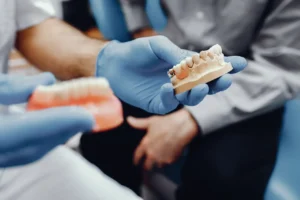
An implant replaces the root: a titanium post goes into the jawbone, bone grows onto it over three to four months, and a crown is fitted on top. Nothing else in your mouth is touched.
A bridge replaces the crown only: the two teeth either side are trimmed down, and a three-unit span is cemented across them. The false tooth in the middle rests on the gum with nothing underneath it.
That structural difference drives everything below.
Cost over twenty years
| Implant | Three-unit bridge | |
|---|---|---|
| Up-front cost | $3,000–$5,000 | $2,500–$5,000 |
| Typical lifespan | 20+ years, often lifetime | 10–15 years |
| Likely replacements in 20 years | 0–1 crown | 1–2 whole bridges |
| Rough 20-year total | $3,000–$6,500 | $5,000–$10,000 |
| Insurance treatment | Major service, often ~50% | Major service, often ~50% |
The numbers above are typical ranges rather than a quote, and they assume nothing goes wrong. What tips the balance further is what happens when a bridge fails: the abutment teeth have already been trimmed and often have decay underneath by then, so the replacement is frequently not another bridge but an implant anyway — after you have paid for the bridge twice.
The question that usually decides it
What condition are the teeth either side of the gap in?
- Both are healthy and untouched — the implant is nearly always the better choice. Cutting down two sound teeth to replace one missing tooth is a real, permanent cost that never appears on the invoice.
- Both already have large fillings or need crowns — the bridge becomes genuinely competitive. Those teeth need covering anyway, so the bridge solves three problems at once.
- One is healthy, one is heavily restored — usually the implant, so the healthy tooth stays whole.
Bone, and why it matters more than it sounds
The jawbone that held a tooth root only stays there if something keeps loading it. An implant does that. A bridge does not, so the ridge under the false tooth slowly shrinks — which after some years shows as a dark gap under the bridge and a change in the shape of the gum.
This is also why waiting has a cost. The longer a gap sits empty, the more bone is lost, and grafting to rebuild it is more expensive than placing an implant while the bone is still there.
Time, and cleaning
A bridge is fitted in two or three weeks; an implant takes three to six months, most of it healing. If you need a front tooth restored before a wedding next month, that difference matters, though a temporary tooth covers the gap in the meantime.
Day to day, the implant is easier: brush and floss it like a normal tooth. A bridge needs a floss threader or an interdental brush to clean underneath the span, every day, for as long as you have it. Bridges usually fail because that step gets skipped and decay starts on the supporting teeth.
When neither is right
If several teeth are missing in a row, or bone is very limited, a partial or implant-retained denture may serve you better than either. And if gum disease is active, that gets treated first regardless — both options fail early in an unhealthy mouth.
Frequently Asked Questions
Q: Is an implant or a bridge cheaper?
A: A bridge is usually slightly cheaper on the day, but over twenty years the implant typically costs less because it lasts longer and rarely needs replacing. A bridge often needs remaking once or twice in that period, and the supporting teeth can develop decay underneath it.
Q: Does insurance cover implants and bridges differently?
A: Both are usually classed as major services at around 50% coverage, but the annual maximum of $1,000 to $2,000 limits what you actually receive in a year. Some policies exclude teeth that were already missing when cover began. We send a pre-treatment estimate so you know before starting.
Q: How long does each take?
A: A bridge takes two to three weeks and two appointments. An implant takes three to six months in total, because the bone needs three to four months to fuse to the post — though you are given a temporary tooth if the gap would show.
Q: Do the teeth next to the gap really have to be cut down for a bridge?
A: Yes, for a conventional bridge — a layer of enamel is removed from both so the crowns fit over them, and that is permanent. Those teeth will need crowns from then on. It is the single strongest argument for an implant when both neighbours are healthy.
Q: Which lasts longer?
A: The implant, in most cases. Published success rates for implants are above 90% at ten years and many last a lifetime, while bridges typically need replacing after 10 to 15 years. Daily cleaning is what decides the outcome for either one.
Q: Can I decide later?
A: You can, but time is not neutral. Bone under an empty gap shrinks, and neighbouring teeth drift into the space, which can make either option more complicated and more expensive. If cost is the obstacle, ask about staging treatment rather than waiting.
Get a straight recommendation
Bring any quotes you already have. We will look at what is either side of the gap, what the bone is doing, and what your insurance actually pays, then tell you which we would choose and why. Call (804) 732-8557 or request an appointment at our Petersburg office.